Agro-ecology is recommended as the most rewarding exercise especially for farmers in areas where rainfall is erratic.
Caritas Masvingo
is spearheading the adoption of agro-ecology methods by peasant farmers ahead
of the 2019/20 season with the promotion of small grains and traditional seed
varieties as they foresee food security for their communities.
According to
Caritas Masvingo Diocese Baseline Data, there is a remarkable improvement in
the percentages as 70% of farmers in Bikita and Gutu have embraced the agro-ecological approach towards farming
through the Equitable Access to
and Use of Natural Resources Programme.
Caritas Masvingo encourages communities of Bikita and Gutu to plant small grain crops that can survive in low rainfall areas.
The Sustainable Livelihoods programme which increases
yields while reducing environmental degradation has proved to be successful
through resuscitation of
lost traditional seed varieties (svoboda,
orange maize, chinyamugage and munyadzagudo), solar water system, use of natural
remedies which provides better solution in fighting armyworm (the use of cow urine, fine sand and yellow
bitter apple/Nhundurwa) and a decrease in use of synthetic fertilizers and
pesticides.
Caritas Masvingo
Coordinator Oppah Rukara appreciated the efforts being made in the Equitable Access to and Use of Natural
Resources Programme and acknowledges that there is looming food insecurity which
is a result of two extreme weather conditions experienced as a result of
El-Nino and Cyclone Idai.
The picture shows the official opening of Chipezeze Bridge in Zaka under the conflict management and mitigation project entitled ‘Shaping Our World (SOW)’.
The Catholic Commission for Justice and Peace (CCJP)
Masvingo recently commissioned Chipezeze Bridge in Zaka District through the
conflict management and mitigation project entitled ‘Shaping Our World (SOW)’
which later on transformed to ‘Re-Shaping Our World (Re-SOW)’.
Zaka District Development Coordinator (formerly DA)
Ndeya Nyede officially commissioned the bridge in the presence of Zaka Rural
District Council (ZRDC) Engineer William Chikwanda and other key stakeholders
of the community such as the Ward Councillor Peter Imbayarwo, local CCJP Peace
Committee, traditional leaders, ZRDC and the villagers of Chipezeze community.
Re-SOW has created conflict education awareness
through trainings and engagement platforms in target communities on how to
peacefully resolve conflicts thanks to the financial support from the Catholic
Relief Services (CRS) facilitated by ‘Collaborative projects for the common
good’ to ensure sustainability of projects.
CCJP Masvingo assisted the construction of a low lying
bridge with seventy bags of cement and three wheelbarrows as a way to support
collaboration which Chipezeze, Mvarume and Masaga communities wished to have
for a very long time.
The Non-Governmental Organization noted that of the
potential 21 target communities that the Re-SOW project was focusing on, only 8
managed to receive assistance after a tightly contested bidding process where
the communities were asked to develop project proposals.
Zaka District Development Coordinator, Nyede also
appreciated the project noting that developmental aid is sustainable as it helps
the communities to grow.
“What is important is development. I am particularly
happy about this project because it is a permanent development.” said
Coordinator Nyede.
Ward Councillor Peter Imbayarwo also appreciated how
the project managed to unite people of Chipezeze, Mvarume and Masaga
communities.
“I am very happy because this bridge is not for one
person. It’s not for two people, but it’s for everyone.” said Councillor
Imbayarwo.
Pastoral Statement of the Zimbabwe Catholic Bishops’ Conference
on current affairs in the country
Published
on 11 September 2019
Dear sisters and brothers in Christ,
all men and women of good will,
Introduction
(1) On the morning of Friday 6 September
2019, we woke up to the sad news of the death of former President of Zimbabwe,
Robert Gabriel Mugabe. We extend our condolences to his immediate and extended
family, the government of Zimbabwe and all the bereaved. May his soul rest in
eternal peace.
The End Does Not Justify the Means
Robert Mugabe with his first wife, Sally Hayfron, on their wedding day, April 1961.
(2) As the day unfolded on Friday 6 September 2019, condolence messages began to pour in highlighting the many good qualities of the late former President. Some dwelt on his broad education and others on his achievements from the liberation struggle to State House as a principled person, liberator, his empowerment of the black majority, pan-Africanist, etc. We, the Bishops of the Catholic Church in Zimbabwe, agree with most of these attributes but they also raise a key question, ‘What went wrong?’ The intentions and the objectives were good but the manner of achieving them raised a number of ethical questions. This is where we, as a country, went wrong and continue to go wrong to this day. The Catechism of the Catholic Church teaches as follows:
“, the intention, and the circumstances make
up the three “sources” of the morality of human acts.
The object chosen morally specifies the act of
willing accordingly as reason recognizes and judges it good or evil.
“An evil action cannot be justified by
reference to a good intention” (cf. St. Thomas Aquinas, Dec. praec. 6).
The end does not justify the means.
A morally good act requires the goodness of its
object, of its end, and of its circumstances together.
There are concrete acts that it is always wrong
to choose, because their choice entails a disorder of the will, i.e., a moral
evil. One may not do evil so that good may result from it.”
(3) The liberation struggle was a last resort, after all
attempts at dialogue and inclusion had failed. Violence can never be the first
option. “ZANU haizombofa yakatsveta
zvombo pasi” (ZANU will never lay down arms), as the popular saying we hear
so often goes, should not mean we resort to arms and violence as the first
option in any situation of conflict including the announcements for
demonstrations. We believe engagement and dialogue will bring about the desired
transformation of our nation. We are deeply concerned about the reported
nocturnal visits by unknown masked men, beatings, torture, sexual assaults,
abductions, harassment of dissenting voices and violent repression of
demonstrations by Police. Such acts contradict the positive narrative of
Zimbabwe’s Second Republic, have no place in a democratic society and there
should be no impunity for those who commit these crimes. The end, in this case
the purported peace, does not justify the means.
Sanctions
(4) The main purpose of sanctions and embargoes is to influence the behaviour of the
The intentions and the objectives were good but the manner of achieving them raised a number of ethical questions.
target country’s government, individuals or groups in the hope that will improve the situation in that country. Zimbabwe has endured the burden of sanctions for long. The impact of the adverse effects of sanctions is still being studied but over the past twenty years, given the number of people who have died from lack of adequate medicines, food, maternal deaths, etc., one can only conclude that the impact has been devastating. As an integral part of the comprehensive and inclusive dialogue we advocate for our country as Bishops of the Catholic Church, Zimbabweans, particularly our leaders, should address the imperatives that spawned sanctions on our country in the first place and genuinely implement reforms that the international community is calling for and to which our Government has expressed commitment. The common good and welfare of our people should spur our leaders to go beyond politicking and belligerence and thus give credence to Government’s call for reengagement, re-engagement which should in the first instance be experienced broadly among ourselves as Zimbabweans and in the second instance, as a united people, with the international community.
Corruption is Zimbabwe’s worst enemy that the current government should crack down on.
Corruption has greatly exacerbated the impact of sanctions
on our country. Let us all unite to fight corruption, which is robing our
nation of its future.
The Land
(5) One wonders for how long our land must remain in
dispute. Sanctions were mainly imposed because of the fast-track land reforms
that were done in Zimbabwe, not because the main political parties do not get
along, etc. All the stakeholders, both local and international, need to speak
the truth in charity, address the real issues and not hide behind a finger.
In the Ecumenical Document, The Zimbabwe We Want, we called for the finalization of the land
question and made some recommendations saying:
“. . . the land question has been the most emotive national
question
that has left
our nation highly polarised. Now is the time to galvanize all our energies to
bring finality to this vexatious issue in a manner that heals the wounds of the
past . . . years. Now also is the time for the Government to show magnanimity
by extending its hand in reaching out to all its citizens, regardless of
political affiliation, race, gender or ethnicity to seek consensus on the way
forward.
As a start, there is general
recognition that the current reforms are irreversible but what is required is
developing a national consensus on how best to address the outstanding issues
and correct the imperfections in the land redistribution process to the benefit
of all citizens who want to build their future on the land as well as to the
benefit of our national economy. Our vision ought to be guided by the principle
that there should be no winners and losers but rather we should all come out of
this experience as winners.” (The
Zimbabwe We Want: 2006). Zimbabwe needs a broad inclusive dialogue to
resolve its historical contentious issues. The Churches are prepared to mediate
as impartial and honest brokers.
Xenophobia
(6) We have also witnessed xenophobic attacks in South
Africa in recent times. One can understand the plight of the poor in South
Africa in the same way one understands the plight of the poor all over the
African continent. However, to them we also say, ‘The end does not justify the
means.’ Xenophobic attacks on fellow Africans are not the answer. Spurred by a
variety of reasons, among them economic and political security, immigration is
as old as the history of mankind. We urge those inclined towards Xenophobia in
South Africa and elsewhere to heed God’s call through the Prophet Jeremiah when
he says:
“Thus says the Lord: Do justice and righteousness, and
deliver from the hand of the oppressor him who has been robbed. And do no wrong
or violence to the resident alien… nor shed innocent blood in this place”
(Jeremiah 22:3)
And to be reminded as the Israelites were reminded in the
book of Exodus: “You shall not wrong a sojourner or oppress him, for you were
sojourners in the land of Egypt…” (Exodus 22: 21-22)
Constitutionalism
(7) In 2013 Zimbabwe produced a
National Constitution that received the approval of all Zimbabweans, an
indicator that the Constitution mirrors the aggregated will and shared
aspiration of the people of Zimbabwe. We should all commit to abiding by the
Constitution of Zimbabwe, rule of law, freedom of speech and protection of
human rights. Our
Constitution and our laws provide us with the means of
achieving our national goals without resorting to any form of violence. Never
again should our good intentions be undermined by bad execution when we have
all the legal tools to realize the Zimbabwe We All Want.
Recommendations
(8) We therefore request all Zimbabweans to
turn their swords into ploughshares and unite in building the Zimbabwe we all
want. We particularly request:
Security Forces to refrain from heavy handedness in
restraining unarmed civilians;
The Zimbabwe Republic Police to investigate all cases of
torture, abductions and wanton beatings and bring the perpetrators to trial;
The Executive and Legislature to enforce, supervise and
oversee impartial implementation of the Constitution;
The Zimbabwean government to listen to and address the
real needs and grievances of people. The use of force to suppress dissent is
unconstitutional and unsustainable;
We call on all leaders to stop corruption and call on all
people to expose corrupt practices at every place. Corruption may have
destroyed the country even more than sanctions.
The Zimbabwe Heads of Christian Denominations (ZHOCD) and
other Churches to convene and facilitate National Days of Prayer. Our Nation
needs God.
Conclusion
We call for genuine dialogue at various levels of society,
apart from the political dialogue. It is only in genuine meeting of hearts that
we can tolerate each other and have a lasting solution to our problems.
Dialogue is the only way to realize our good intentions. We need as in 2008 a
political dialogue which will settle the impasse that has reduced our country
to two warring camps. President R. G. Mugabe has also left us a legacy of
political dialogue. If he could talk to Mr. M. Tsvangirai and come to a
settlement, surely the successors of these opponents, for the good of the
nation, can do the same. The Churches are ready to facilitate such dialogue.
It was also the late former President, Robert
Gabriel Mugabe, who launched the Zimbabwe
We Want Discussion Document in 2006 at the Catholic University in Zimbabwe.
We would like to conclude by asserting that, as illustrated in Zimbabwe We Want Discussion Document, we
believe the need for:
A shared national vision;
Political tolerance;
National healing and reconciliation;
Implementation of the constitution;
Eliminating corruption and
Addressing land and economic challenges.
May the God Almighty bless the nation of
Zimbabwe and grant it courage to build a Zimbabwe that is free, tolerant,
peaceful, prosperous and God fearing.
God bless you all.
+Robert C. Ndlovu, Archbishop of Harare (ZCBC President)
+Alex Thomas, Archbishop of Bulawayo (ZCBC Vice President)
+Paul Horan, Bishop of Mutare (ZCBC Secretary/Treasurer)
+Michael D.
Bhasera, Bishop of Masvingo & Pontifical Administrator of Gweru
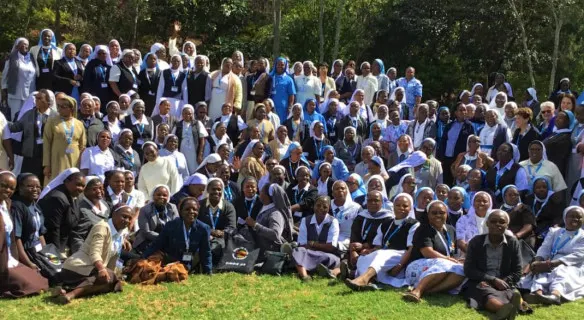
Delegates to the SIGNIS-Africa Congress and Assembly in Addis Ababa, Ethiopia pose for a group photo at a the HUB Hotel
The digital media should be at the service of
integral human development especially that of the youth in Africa who are the
majority of the population in the continent. This was raised at the
SIGNIS-Africa General Congress and Assembly held in Addis Ababa, Ethiopia from
3 – 7 September under the theme, The African Youth in the Digital World;
Promoting Creativity for Integral Development. The digital age brings a lot of
opportunities and challenges and the youth need to be guided in their
interaction with everchanging media technologies so that they use them to
better their life through improved creativity, sharing faith and finding
solutions to socio-economic and political problems in the world.
In his opening remarks to delegates at the
SIGNIS Congress, His Eminence, Cardinal Souraphiel Berhaneyesus applauded
Church communicators in Africa for taking time to evaluate how the media can be
used to improve the life of the youth in a continent riddled with conflict and
poverty. He said the youth tend to be more confused if they are not guided in
their use of digital media.
Cardinal Berhaneyesus D. Souraphierl giving an interview to journalists during the SIGNIS-Africa Congress in Addis Ababa, Ethiopia.
“The youth around the world are confused
because of technology and the youth of Africa are more prone to confusion in their
use of digital media and the church need to help and guide them,” said Cardinal
Berhaneyesus, emphasizing that Catholic media professionals have the
responsibility of forming the conscience of society for integral human
development.
Cardinal Yesus stressed that if the youth are
properly guided in their interaction with the media, they will come up with new
solutions to some current and old problems that bedevil Africa. He said the
youth are creative, possible agents and artisans of their destiny.
Bishop Lisane Chiristos challenged Catholic
media practitioners to use the media to bring he grace of God by making them
instruments of evangelization. He said there cannot be evangelization without
communication and that communication is not just another activity of the Church
but is at the centre of the Church’s mission and life. Bishop Chiristos pointed
out that the new media has given the Church in Africa opportunities of
preaching the Gospel widely and directly.
“Without communication, there can never be
evangelization. Bringing communication professionals together gives confidence
that the Gospel will be communicated to all nations,” he said.
Integral human development is about the
struggle against hunger, poverty, unemployment, corruption and political strife
at all levels of society. The involvement of the youth in the digital media
will open up more avenues for dealing with these problems, promote
transparency, demand accountability and introduce new ways of production of
goods and services.
His Eminence, Cardinal Berhaneyesus D. Souraphierl, Metropolitan Archbishop of Addis Ababa and President of CBCE flanked by SIGNIS Officials including Ms. Helen Osman, President for SIGNIS World.
In a speech delivered on his behalf, Cardinal
Peter Turkson, Prefect of the Dicastery for Integral Human Development in the
Vatican, linked integral human development to the protection of the environment
and equal distribution of resources paying attention to the needs of the youth
and children. Cardinal Turkson called for promotion of creativity by the youth
so that they bring change to the welfare of humanity.
He said: “Young people can contribute to the
conviviality that cuts across borders of language, race and politics. They can
breathe new life in every situation by their creativity and new ways of looking
at things. Africa must be developed by young people.”
The SIGNIS-Africa President, Fr. Walter
Ihejirika from Nigeria affirmed that the congress aimed at creating practical
pathways for promoting the welfare of youth and children in the changing
digital world. He stressed the need of building SIGNIS- Africa into a strong
communication association capable of addressing communication challenges in
Africa for purposes of empowering the youth. He acknowledged the presence of
the leadership of the Church in Africa as an eloquent testimony of the premium
which the church places on communication.
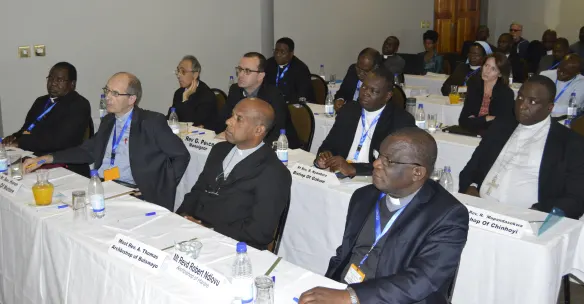
Delegates to SIGNIS-Africa Congress and Assembly at the AU Headquarters in Addis Ababa, Ethiopia.
Ms. Helen Osman who is the World SIGNIS President
called for digital citizenship and urged Catholic journalists to punctuate
their work with faith and not fake news. She said the church was facing a
crisis of credibility at different levels and the church media should help
create spaces of witness though digital media.
President of SIGNIS World, Ms. Helen Osman addressing the SIGNIS Congress and Assembly delegates in Addis Ababa, Ethiopia.
“The purpose of the Catholic media is to inform
and form public opinion in line with the Gospel. Catholic communicators should
establish platforms of honest dialogue through the digital media,” Osman said.
Osman called on Catholic journalists to
challenge the church to be accountable and transparent in its representation of
Christ.
Bishop Moses Hamungole buttressed the objectives of the congress by calling for serious pastoral formation of Catholic journalists for the care of children and young people in Africa. He stressed that without proper training and formation of journalists on taking care of children and the youth, they cannot fulfil their mandate in protecting the interests of children.
According to Bishop Hamungole, the functions of the media are connected to the socialization of children. Therefore, pastoral formation of journalists helps them to pay attention to the needs of children.
Bishop Moses Hamungole stressing the importance of formation of Catholic journalists for the protection of young children.
The Congress also addressed issues to do with
technological and cultural means in combating cybercrime in Africa, harnessing
ICT in youth development and the role of SIGNIS Services Rome in the digital
development of African youths. All member countries were encouraged to improve
the structure and visibility of SIGNIS at local, national and regional level.
The Bishop of Masvingo Diocese Michael Bhasera tasked Marian Guilds to be missionaries who evangelize their communities whilst supporting priests and religious. He said this at the National Marian Guilds in Zimbabwe 6th Congress held under the theme Baptised and sent in the footsteps of Mary the star of evangelization that took placefrom the 22nd to the 25th of August 2019 at Gokomere Mission.
Addressing
the Congress partakers which included Solidarity of Mary, Legion of Mary, Mary
Mother of Perpetual Help, Mary of Mount Carmel, Mary Queen of Heaven Guilds and
other Catholic Guilds that attended the congress, the Masvingo Diocese shepherd
pointed out that the laity should take the lead in evangelizing.
“You
are not alone, Mother Mary is with you, she walks with you, Marian Guilds are
instruments of holiness and evangelization, the Church looks to you to be fully
involved so that the light of the gospel shines everywhere, without your full
involvement light of the gospel will never shine to the whole world, the salt
of the earth will be salt in the earth, there are places where the priests and
religious cannot reach and do not have to reach, but only you can reach those
places, go and evangelize,” said Bishop Bhasera.
Bhasera also noted that it is essential that everyone renews his missionary vows to fulfill the discipleship of Jesus and being members of the Catholic Church.
“I
believe that you are inspired by the universal theme of the Extraordinary Mission
Month to choose this theme; Pope Francis has invited us to celebrate this
important moment in the Church as a way of missionary renewal, we need this
renewal ourselves, we have always been aware of our being disciples of Jesus,
our being members of the Church and our being members of different Marian
Guilds,” said Bishop Bhasera.
Spontaneously
the Diocese of Masvingo is under the patronage of Our Lady Mary Queen of Peace and
it presented the Marian Guilds a platform to glorify their Patron Saint in the
midst of the Marian terrain.
About five local religious congregations in Zimbabwe held their General Chapter to determine the way forward of these different institutions. The congregations are the Handmaids of Our Lady of Mount Carmel (HLMC), Sisters of the Infant Jesus (SJI), Brothers of St. Paul, Little Children of Our Blessed Lady (LCBL):
Little Children of Our Blessed Lady (LCBL) Leadership Team
Christians in Gokwe are enthusiastic to support the new missions being opened in Gokwe.
Gokwe Diocese is a Church on the move as witnessed by numerous developmental projects lined up for the local church. The diocese has come of age in self-supporting, self-propagating and self-ministering efforts. A visit to the diocese and a tour of some projects revealed that the diocese has great potential to transform the lives of people in the surrounding communities. When Bishop Rudolf Nyandoro took over, Gokwe Diocese already showed positive signs of maturity from the well laid foundation by his two predecessors. Today, the diocese continues to shape up with faith in action. Self-reliance projects, schools and new missions serve as evangelizing tools for the diocese that places people at the centre. With the country’s failing economy and people’s loss of trust in the government, the only hope for the people of Gokwe lies in the diocese’s initiatives that are pro-poor in nature. Continue reading →
Bishop Michael Bhasera (in white cassock) flanked by Fr. Walter Nyatsanza, Professor Ranga Zinyemba, National Education Secretary, Sr. Theresa Nyadombo and others at the launch of the Catholic University Campus in Masvingo recently.
The Catholic University of Zimbabwe (CUZ) officially launched the Masvingo Diocese campus on 19 July 2019 opening the first phase of the Bachelor of Education degree programs at Bondolfi Teachers College starting August 2019. Continue reading →
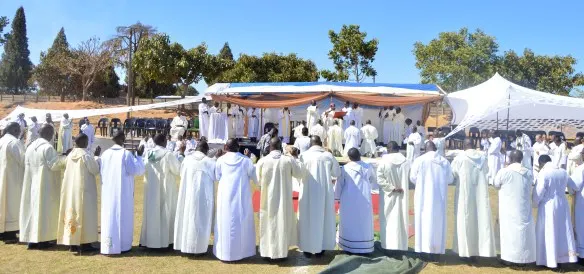
Priests encircle the newly ordained priests while Bishop Bhasera prays over them.
Jostling for power and positions are wrong ambitions in Catholic priesthood. This was said at an ordination of five priests at Mkoba Stadium in Gweru on 13 July 2019. The five were ordained by Bishop Michael Bhasera, the Apostolic Administrator of the Diocese of Gweru. Among the five, Frs. Kudakwashe Chidhe, Aaron Mpofu, Stephen Mangoma and Augustine Manhovo are diocesan priests belonging to the Diocese of Gweru while Fr. Tembo Samuel Zhuva is of the Order of the Oblates of Mary Emaculate present in the Archdiocese of Bulawayo. Continue reading →
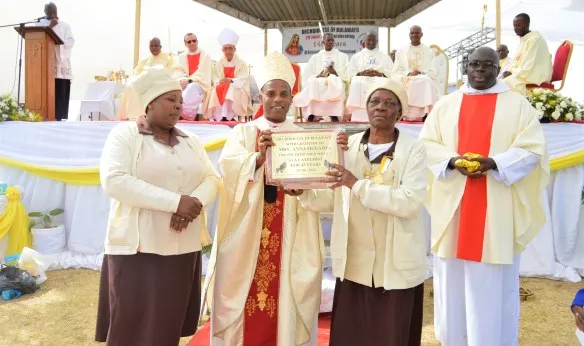
Archbishop Alex Thomas presents a plaque to honour Mrs. Anna Mugadza for her sterling work in the Archdiocese as a catechist for 45 years.
Catechists in Matebeleland received a special honour during the Archdiocese of Bulawayo’s commemoration of 140 years of Christianity held on 29 June 2019 at Our Lady of Fatima in Pumula South. Of special mention was Mrs. Anna Mugadza who received a special recognition from Pope Francis for her sterling contribution as a catechist in the Archdiocese of Bulawayo for 45 years and the late Mr. Alexander Regis Gwenelo. Continue reading →
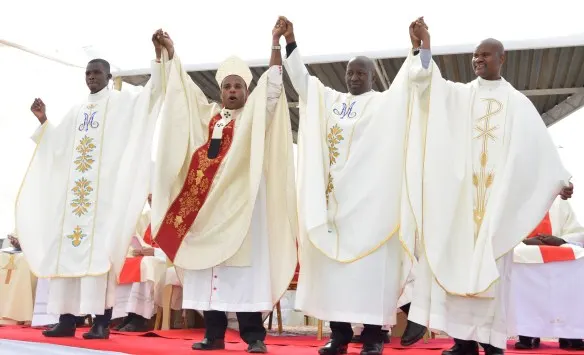
Archbishop Alex presents the newly ordained priests to the congregation.
The Archdiocese of Bulawayo on 29 June 2019 celebrated 140 years of Christianity in Matabeleland and 25 years as a metropolitan see. The celebrations were a symbol of massive spiritual and infrastructural development by the Catholic Church in Matebeleland from the time of the first missionaries in 1879 and their settlement at Empandeni in 1887. The celebrations, held at Our Lady of Fatima Parish, Pumula South were coupled with the priestly ordination of Fr. Prize Kevin Madzivanyika CMM, Fr. Brian Francis Kandlela and Fr. Vusimuzi Golden Moyo. Continue reading →
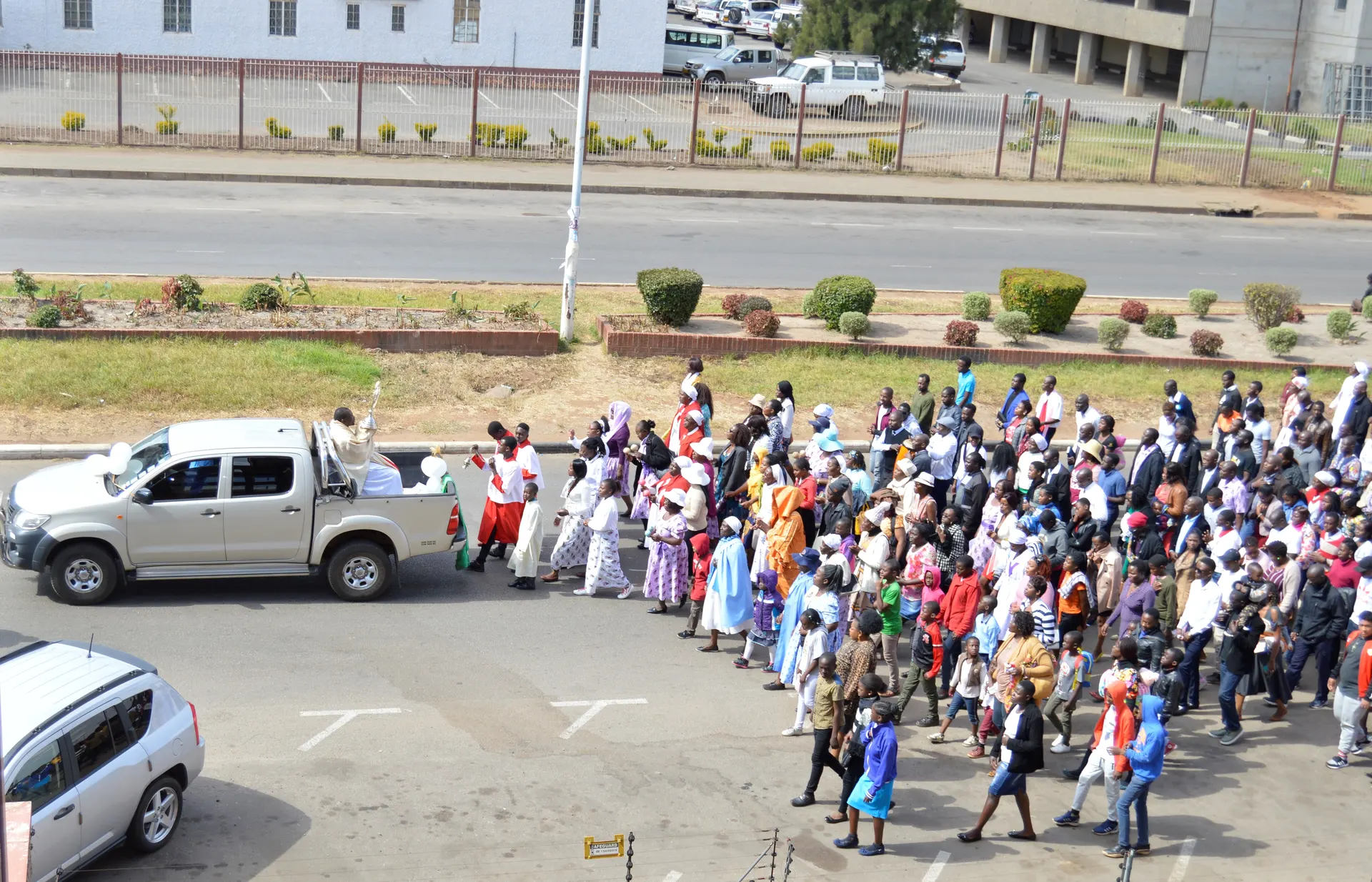
Fr. Kennedy Muguti in a car, lifts a monstrance with the blessed sacrament in a procession along Simon Muzenda Street in Harare.
The Catholic Church today celebrates the feast of the Corpus Christi to proclaim the fact of transubstantiation which means transformation of bread and wine into the body and blood of Christ. The festival of Corpus Christi celebrates the Eucharist as the body of Christ. Continue reading →
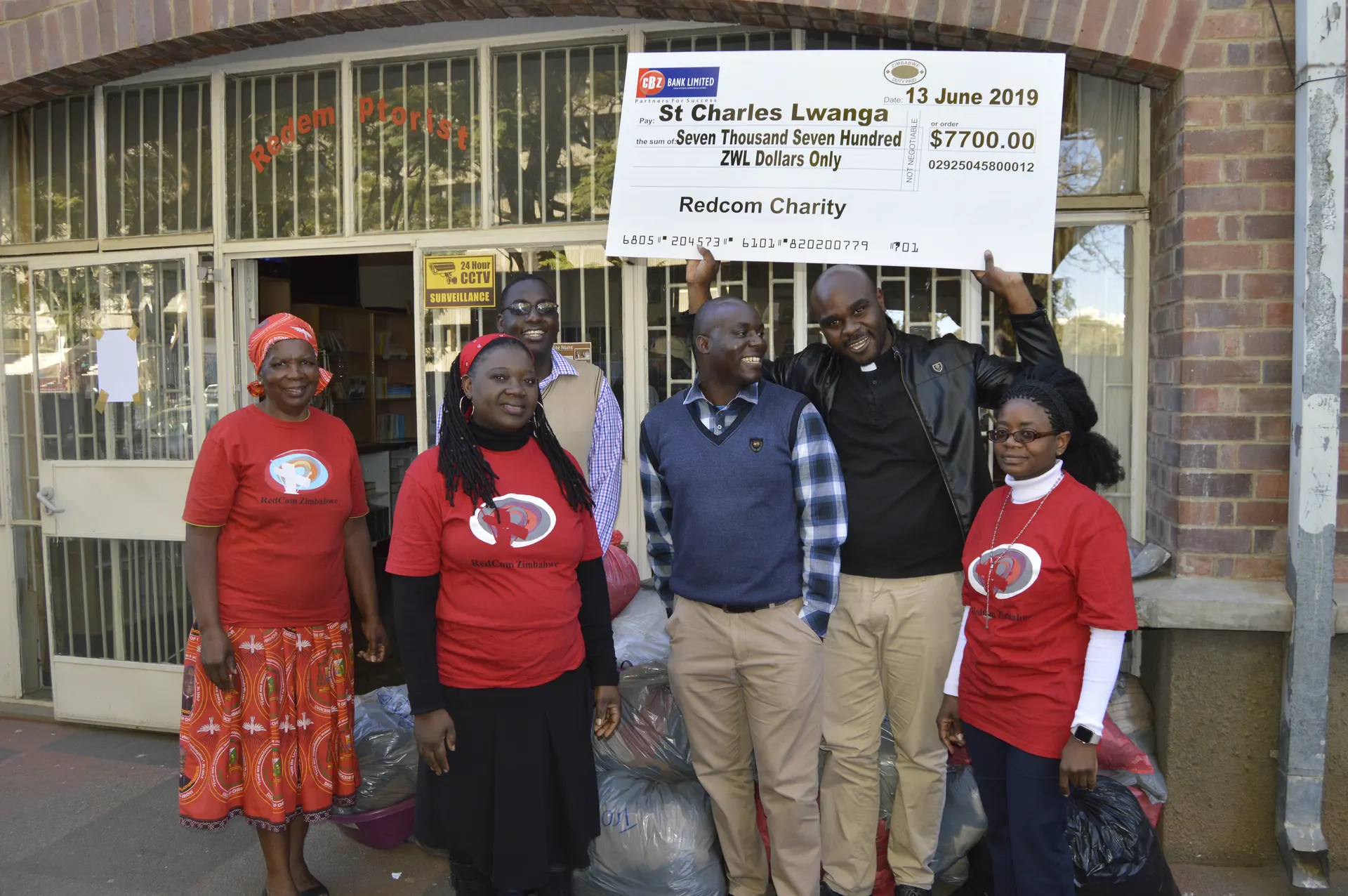
RedCom Coordinator, Mrs. Dorothy Zakeyo, Mrs. Mombo, Br. Kenneth Temba, Mr. Justice Makura, Fr. Talent Muhomba lifting the cheque and Mrs. Dhlamini pose for a picture after the presentation of goods meant for the victims of Cyclone Idai.
Donations towards Cyclone Idai victims continue to pour in with Redemptorist Communications (RedCom) donating RTGS7 700.00 towards the reconstruction of St. Charles Luwanga Secondary School in Chimanimani that was severely affected by the disaster. The money was handed over to Fr. Talent Muhomba who represented the Bishop of Mutare, Rt. Rev. Paul Horan at a handover ceremony that took place at the Redemptorist bookshop in Harare on Monday, 17 June 2019. Continue reading →
All interested candidates can hand in their applications with detailed CV’s and contacts at the Most Holy Trinity Cathedral or email to [email protected] or [email protected] by Thursday the 6th of June 2019. Shortlisted candidates will be contacted for interviews. For any further details contact us on .